



Cannes 2026 Dispatch: African Cinema and the Global Black Presence Rise Beyond Erasure
2026 Cannes Film FestivalBFM News and UpdatesFestivalsUncategorized May 11, 2026 Floyd Webb

At a moment when political forces in the United States are attempting to narrow, sanitize, and erase the complexity of African American history and culture from public life, the global landscape tells another story entirely. Here at the Cannes Film Festival, the Black and African presence is not retreating. It is expanding.
The crossroads of world cinema remain defiantly international, defiantly multilingual, defiantly Black.
As poet Sterling Brown once wrote, riffing on Carl Sandburg, “The strong men keep on coming.” And this year in Cannes, the strong women do too. They always show up.
If American political culture is currently trapped inside another cycle of historical amnesia and cultural backlash, Cannes offers a reminder that Black culture has never belonged solely to America in the first place. Its circulatory system is global. Its memory is transnational. Its future continues to be written in Lagos, Kigali, Johannesburg, Kingston, London, Chicago, Port-au-Prince, Dakar, and São Paulo as much as Los Angeles or New York.
The attempted silencing of Black culture in the United States increasingly feels less like a decisive historical turn and more like a temporary distortion — a blip on the global radar. The resilience remains intact.
This year’s official selection includes three African films in the prestigious Un Certain Regard section, a sidebar long recognized as one of Cannes’ most important incubators for daring and emerging cinema.

Ben’imana by Marie-Clémentine Dusabejambo marks the first feature film by a Rwandan woman director ever selected for Cannes. Co-produced between Rwanda, Gabon, and Côte d’Ivoire, the film examines community-led Gacaca justice trials in the aftermath of the Rwandan genocide — continuing African cinema’s long engagement with memory, trauma, and collective repair.
Congo Boy from Congolese filmmaker Rafiki Fariala follows a young aspiring musician displaced from the Democratic Republic of Congo and struggling to survive and create in the Central African Republic. Music, migration, and fractured identity remain central concerns of contemporary African storytelling, especially among younger filmmakers confronting displacement not as abstraction, but lived inheritance.

French-Moroccan filmmaker Laïla Marrakchi returns to Cannes with La más dulce (Strawberries), tracing the lives of two Moroccan women who travel to Southern Spain as seasonal strawberry laborers. The film enters the growing cinematic conversation around migration, invisible labor, and the feminization of precarious work across the Mediterranean corridor.
None of these films compete for the Palme d’Or, but Un Certain Regard has increasingly become one of the most vital spaces in Cannes for formally adventurous and politically urgent cinema. In recent years, some of the festival’s most exciting discoveries have emerged from this section rather than the main competition itself.
That trajectory continued in 2025 when British-Nigerian filmmaker Akinola Davies Jr. received a Special Mention for the Caméra d’Or for My Father’s Shadow, signaling the growing international sophistication and confidence of Black diasporic cinema.
Outside the official competition, the parallel sections are overflowing with Black creative energy.
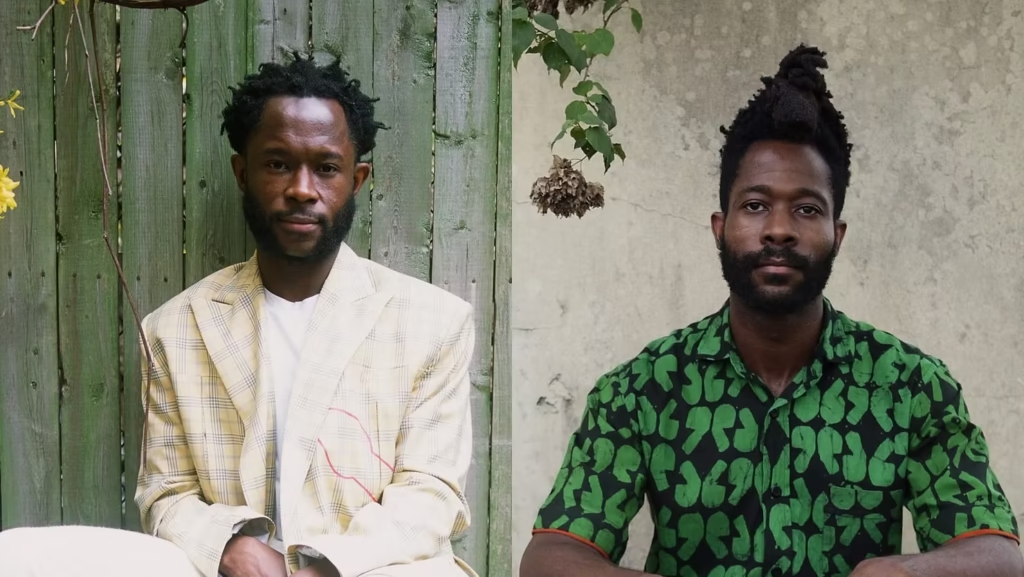
In the prestigious Directors’ Fortnight section, Nigerian twin filmmakers Arie Esiri and Chuko Esiri present Clarissa, a bold reimagining of Virginia Woolf’s Mrs. Dalloway relocated to contemporary Lagos and shot on luminous 35mm film stock. The cast itself reflects the transnational architecture of Black cinema today: Ayo Edebiri, David Oyelowo, Sophie Okonedo, Toheeb Jimoh, and India Amarteifio.

The Sudanese filmmaker Ibrahim Omar arrives with Nothing Happens After Your Absence, while Moroccan-French director Saïd Hamich Benlarbi presents In Search of the Grey Bird with Green Stripes.
Meanwhile, African American creative presence at Cannes is increasingly operating through a sophisticated ecosystem of advocacy organizations, financing initiatives, independent showcases, and cultural diplomacy rather than relying solely on entry into the main Palme d’Or competition.
The Croisette itself has become an active terrain of institution building.

Organizations like African American Women In Cinema (AAWIC) are mounting major international activations directly at Cannes. Their May 19 keynote panel, “The Politics of Black Women in Film,” brings together Emmy-nominated editor Princess A. Hairston, entertainment executive Lamonia Brown, and filmmaker Dr. A’Cire Newby to discuss power, authorship, and representation inside the global industry.
At the same time, longtime inclusion advocate Yolonda Brinkley is being honored with the 2026 Luminary Award at Pavillon AfroNova for more than seventeen years of work pushing diversity initiatives inside Cannes through her pioneering Diversity Day in Cannes platform, supported in part by JuVee Productions.
What becomes visible this year is not simply representation, but infrastructure.
Across the Marché du Film, Black producers, financiers, festival programmers, and distributors are actively constructing transnational ecosystems connecting Hollywood, Black British cinema, Nollywood, Francophone Africa, and emerging independent African production centers.
The Pavillon AfroNova and AfroCannes have become central nodes in that architecture.
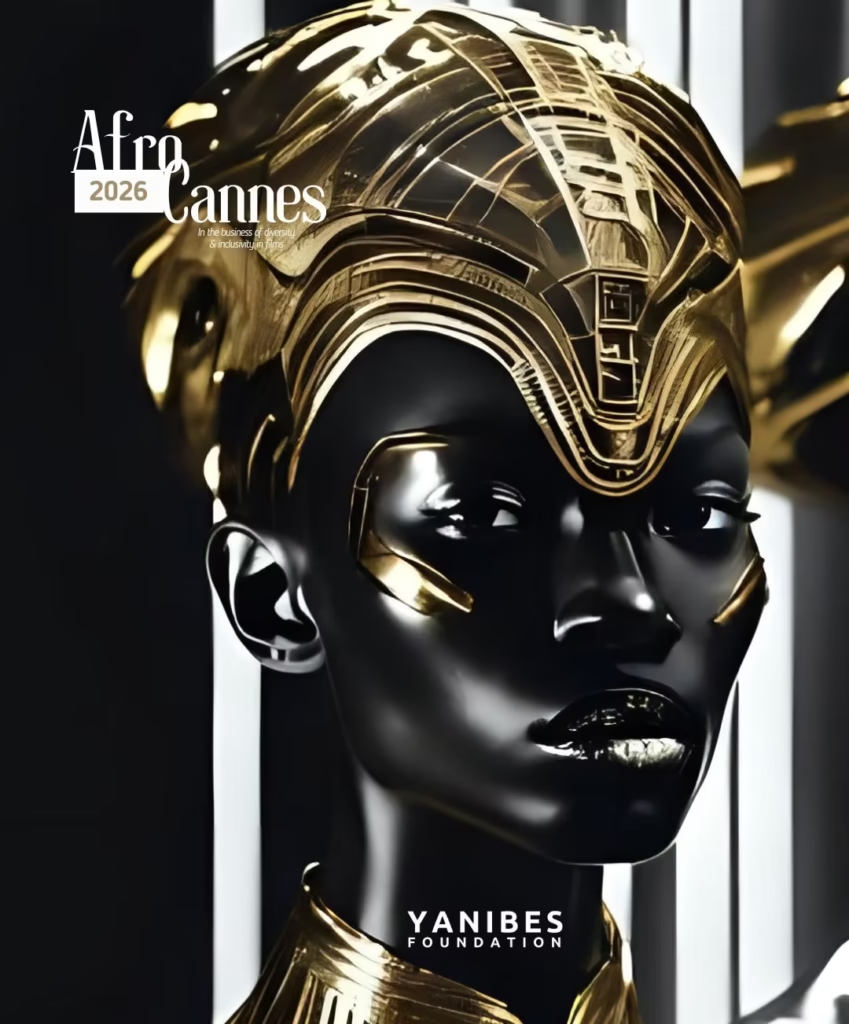
Launched in 2022 by the Yanibes Foundation, AfroCannes has evolved into one of the most dynamic Black diaspora gatherings at Cannes. Operating from May 15–19 at Villa Pompadour, the four-day summit includes panel discussions, screenings, investor meetings, networking receptions, and cultural showcases centered around this year’s theme: “Narrative and Cultural Sovereignty.”
That phrase may ultimately define the larger political significance of Black Cannes 2026.
Because the story here is no longer simply about access to European validation. It is about ownership of narrative systems themselves.
At AfroCannes and Pavillon AfroNova, discussions are increasingly focused on African-controlled financing pipelines, international co-production agreements, animation investment, streaming distribution, audience ownership, and cultural self-determination. Lagos-based Africa International Film Festival is representing Nigeria as the sole African city featured in Cannes’ curation initiatives, while projects like Bem Pever’s political agribusiness thriller A Land Apart starring veteran actor Richard Mofe-Damijo signal the growing ambition of African genre and political cinema alike.
Even the broader festival lineup reflects a world increasingly preoccupied with technological anxiety, displacement, and fractured identity. South Korean auteurs dominate much of the critical conversation this year, with Na Hong-jin’s Hope generating industry speculation while Hirokazu Kore-eda returns with the AI-themed Sheep in the Box. The jury itself, headed by Park Chan-Wook, reflects the continuing eastward and southward shift in global cinematic influence.
Meanwhile, Hollywood increasingly feels like only one node in a much larger planetary storytelling network.
For Black filmmakers, critics, producers, and audiences, that matters profoundly.
Because while American institutions debate whether Black history should even be taught, Black artists around the world continue making work that refuses disappearance. They continue documenting migration, labor, war, spirituality, colonial aftermaths, ecological collapse, memory, joy, and futurity.
They continue building images against erasure.
And here in Cannes, on the Mediterranean edge of empire and commerce, one thing becomes unmistakably clear:
Black cinema did not wait for permission to survive. It survived because the strong kept coming.
Key African and Black Diasporic Presence at Cannes 2026
Official Selection — Un Certain Regard
- Ben’imana — Marie-Clémentine Dusabejambo
- Congo Boy — Rafiki Fariala
- La más dulce (Strawberries) — Laïla Marrakchi
Directors’ Fortnight
- Clarissa — Arie Esiri and Chuko Esiri
- Nothing Happens After Your Absence — Ibrahim Omar
- In Search of the Grey Bird with Green Stripes — Saïd Hamich Benlarbi
African American and Diaspora Industry Presence
Africa International Film Festival representing Lagos in Cannes market programming
African American Women In Cinema (AAWIC) — “The Politics of Black Women in Film” panel
Yolonda Brinkley honored with 2026 Luminary Award
AfroCannes — Theme: “Narrative and Cultural Sovereignty”
Pavillon AfroNova — financing, co-production, and Black global cinema hub

